Flying bail injuries, never again.
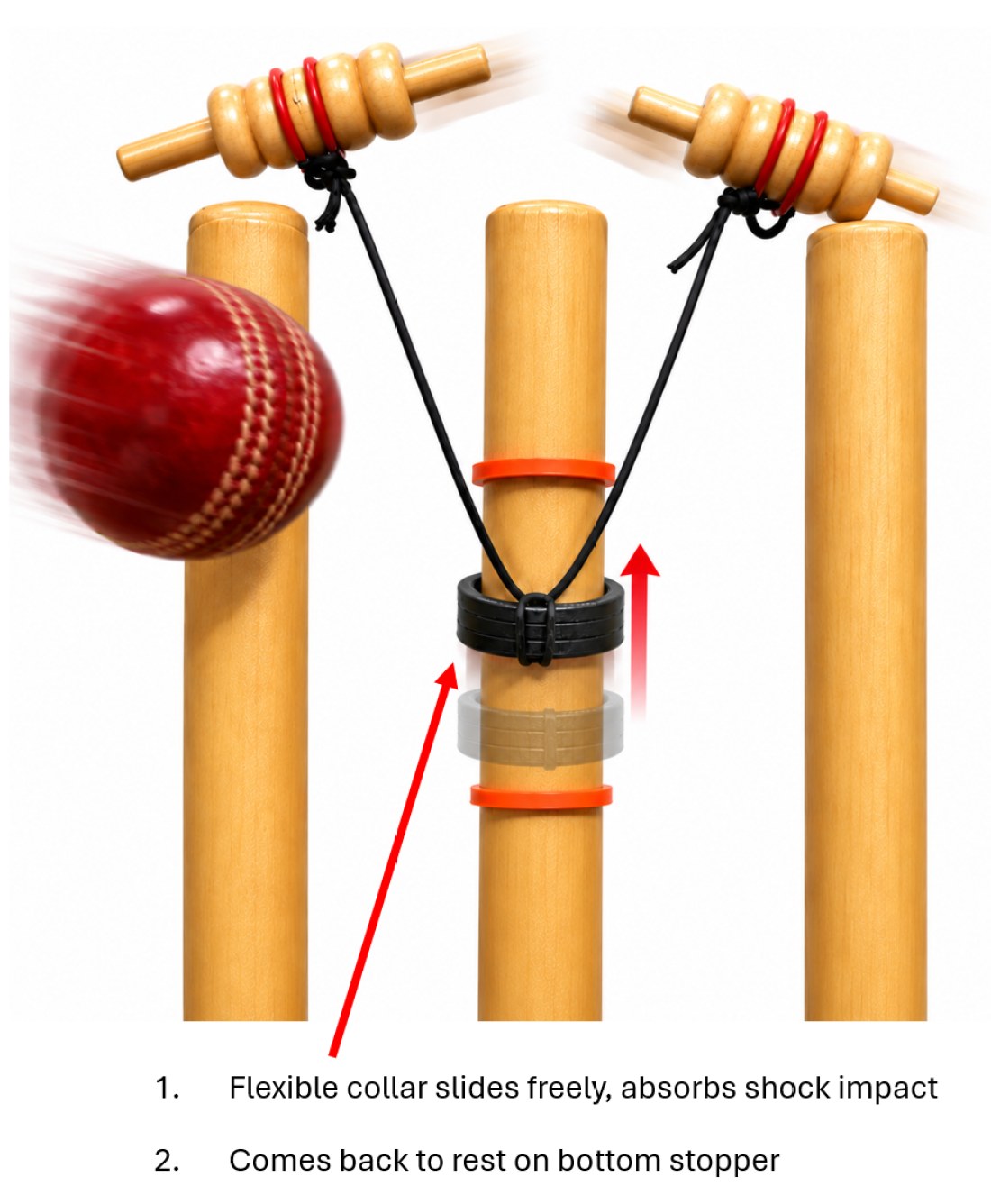
A bail guard is a simple device that tethers cricket bails to the wicket, allowing them to lift and fall normally while preventing them from becoming dangerous projectiles. The design is freely published and available for anyone to build, use, manufacture or improve.
Where it has been on the stumps
Every dot is a place where bail guards were fitted for competitive matches, sized by the games counted there from official scorecards. It started in Dallas–Fort Worth; Minor League Cricket took it across the country in September 2026.
Used in games
These organizations chose to lead on player and umpire safety, and let the device be tested in real, competitive matches.
How it works
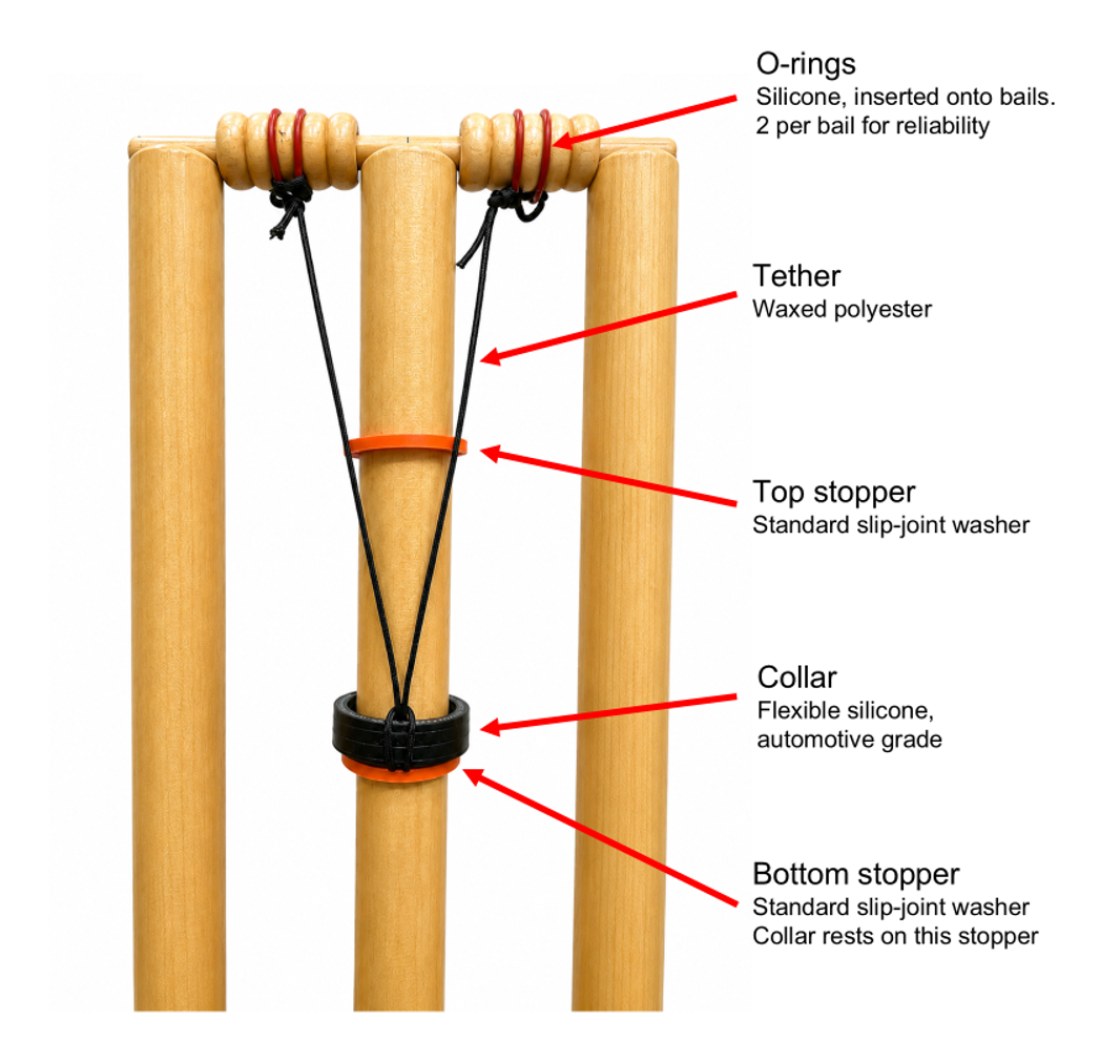
Four inexpensive parts on the middle stump, and a tether to each bail. Nothing is drilled and nothing is modified.
Initial setup
On ball impact
Two minutes with Aashi and Anish: why a flying bail is far more dangerous than it looks, how four cheap parts fix it, and what it looks like in real matches.
Design principles
Eight principles the device had to meet. Everything about how it works, and every alternative design we set aside, follows from them. Each one has a name, so the rest of this site can point at it.
Flying bails can cause severe injuries
Bails are small, hard, and leave the stumps at speed, at head height for the people standing closest. These are not hypothetical cases.
7 personas are in range
Up to half the field is in the firing line. Every single ball.
And behind every one of them, a parent, a teammate or a friend watching from the boundary.
Children are the most exposed
A younger player's eyeline is lower and closer to the bails, reactions are still developing, and softer tissue and bone means an impact does more damage. Most youth cricket is played without any eye protection at all.
The Laws already allow this
This is not a proposal to change cricket. In 2017 the MCC wrote a provision into the Laws specifically for devices like this one.
“Devices aimed at protecting player safety by limiting the distance that a bail can travel off the stumps will be allowed, subject to the approval of the Governing Body for the match and the Ground Authority.”Laws of Cricket, 2017 Code, 3rd Edition 2022. Marylebone Cricket Club. ESPNcricinfo report
A bail guard is exactly the device that clause describes. Using one needs no law change and no special dispensation, only the agreement of your league and your ground, which the Law already anticipates.
Published, not patented
We had something patentable and chose to publish it instead. The full design is archived on Zenodo as a defensive publication, first released in October 2025, under a Creative Commons Attribution licence. That makes it prior art, so the mechanism stays permanently free for anyone to build, sell or improve, and nobody can patent it out from under the game later.
The deeper engineering questions and alternate designs considered are answered in the supplemental technical FAQ.
Every field trial number on this page can be reproduced. The scorecard counts, the scrapers that produced them and the per match reports are all in the field trial repository on GitHub.
Everything, in order
Two minutes gets you the idea. Ten gets you the evidence. Work down the list as far as you want to go.
How often bails come off
Every dismissal below physically dislodges the bails, the exact moment a guard is engaged. Counted from official league scorecards, not estimated.
| Dismissal type | Count | Share |
|---|---|---|
| Total | 4,694 | 100% |
Hit wicket is 0.4% of the total, a real but very thin slice. The bar and table views show it clearly.
This is a lower bound, deliberately
These counts come only from completed dismissals on the scorecard. They do not capture the many other times the bails are dislodged:
- Run out and stumping attempts where the batter was not out
- A bowled or hit wicket off a no ball
- Any other ball that hits the stumps without a wicket being given
The real number is higher. We count what can be verified from official records, and we make no claim that the device prevented any particular injury, only how often it would be engaged.

Help get this in front of the game
We are asking cricket's governing bodies to review the bail guard, and local leagues to try it. Support this initiative.
Share it with the cricket lovers you know. Most people have no idea this is a solved problem.
Talk to us
Whether you want to try bail guards in your matches, make your own, get the design files, or have someone speak to your league, this is where to start. There is nothing to buy and nothing to order from us.